
Introduction
Neural networks are no longer an isolated research topic. They are now a production technology used in computer vision, language models, recommendation systems, and automation tooling. For practitioners, the challenge is not only to use libraries but to understand model behavior well enough to design, debug, and evaluate systems responsibly.
This article is intentionally structured as neural networks explained in a clear academic style: formal where precision matters, and practical where implementation decisions matter. If your goal is to understand how neural networks work from first principles while staying connected to real engineering constraints, this guide is designed for you.
For related production context, see How AI Agents Actually Work and AI-Powered Developer Workflows.
What neural networks are
A neural network is a parameterized function that maps an input vector to an output vector by composing multiple affine transformations and nonlinear activations.
Formally, for input x, parameters theta, and model f_theta:
y_hat = f_theta(x)
The network learns theta by minimizing a loss function over training data. In that sense, neural networks are not rule-based systems; they are optimization-based statistical models.
Historical context
Perceptron
In 1958, Frank Rosenblatt introduced the perceptron, a linear classifier with a threshold activation. It demonstrated that machines could learn decision boundaries from data, but it was limited to linearly separable problems.
Backpropagation
In the 1980s, the practical adoption of backpropagation transformed the field. The method applies the chain rule of calculus to compute gradients efficiently through layered compositions, enabling multi-layer training.
Deep learning
From roughly 2010 onward, three factors converged: larger datasets, GPU acceleration, and improved training techniques. This convergence enabled deep architectures to outperform traditional approaches in vision, speech, and language. What we call deep learning basics today are built on this period of scaling and methodological refinement.
Why they matter today
Neural networks matter because they offer a flexible function-approximation framework that can learn useful representations directly from raw or minimally engineered data.
In practice, this leads to:
- Strong performance on unstructured data (text, images, audio).
- End-to-end learning pipelines that reduce manual feature engineering.
- Transfer learning, where pre-trained representations accelerate new tasks.
- Architecture specialization (CNN, RNN, Transformer) for different data modalities.
Biological inspiration
Biological neuron vs artificial neuron
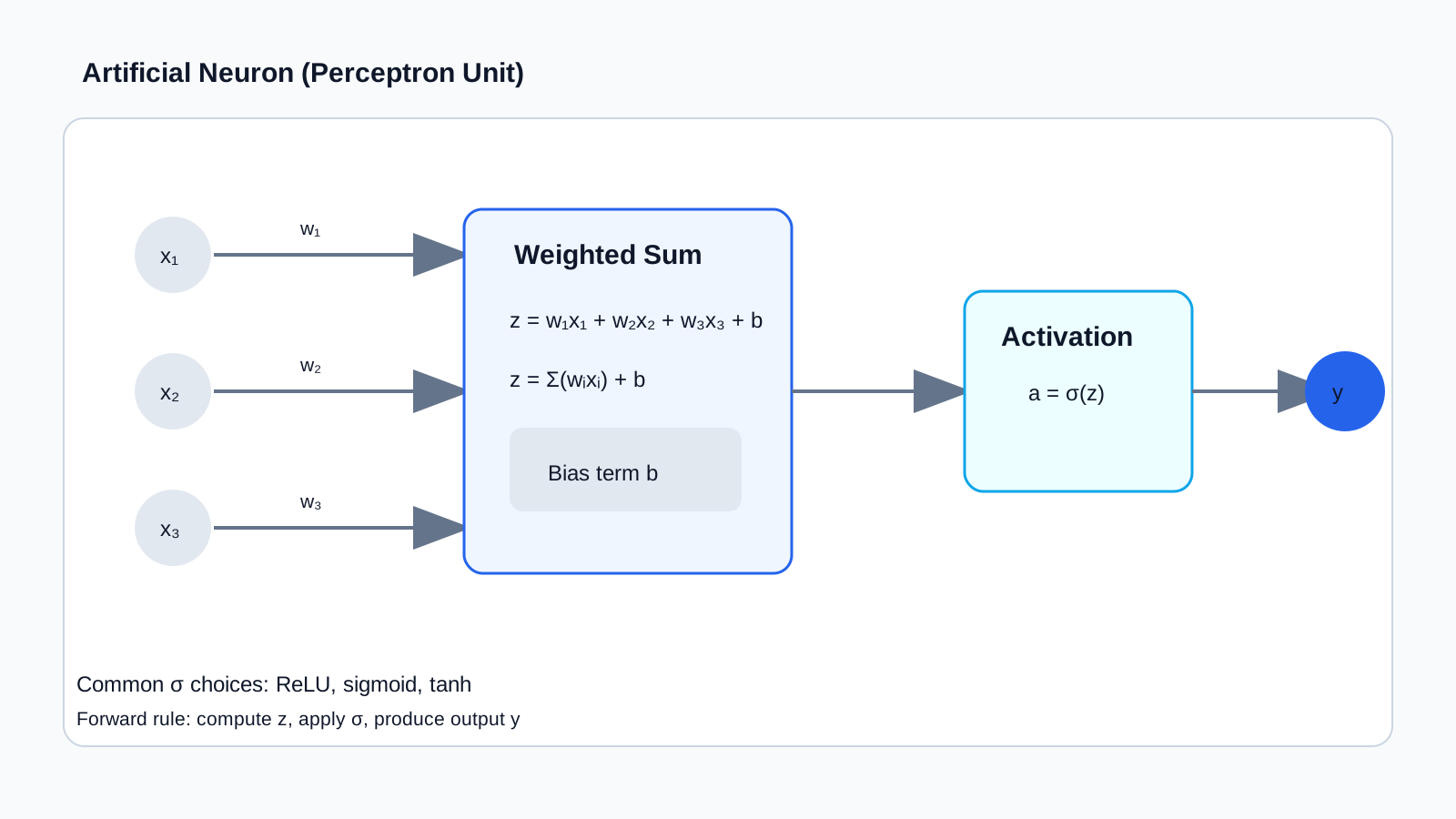
A biological neuron integrates electrochemical inputs from dendrites, triggers an action potential when membrane thresholds are reached, and communicates via synapses. An artificial neuron is a mathematical abstraction that computes a weighted sum plus bias, then applies a nonlinear activation.
Key differences
The analogy is pedagogically useful but technically limited:
- Biological neurons are dynamic, stochastic, and biophysical.
- Artificial neurons are static algebraic operators during a forward pass.
- Biological learning is local and complex; artificial training is global gradient optimization.
- Temporal signaling in brains is event-driven; many neural models are synchronous matrix operations.
Mathematical foundation
Weighted sum
For one neuron with inputs x_i, weights w_i, and bias b:
z = sum_i (w_i * x_i) + b
This affine transformation is the core linear operator.
Activation function
A nonlinear activation a = sigma(z) enables the model to represent non-linear mappings. Common choices:
- ReLU:
max(0, z) - Sigmoid:
1 / (1 + exp(-z)) - Tanh:
tanh(z)
Without nonlinearity, stacked layers collapse into a single linear transformation.
Loss function
The loss measures prediction error. Typical choices:
- Mean Squared Error for regression.
- Cross-Entropy for classification.
For one sample in multi-class classification with target distribution y and prediction y_hat:
L(y, y_hat) = -sum_k y_k * log(y_hat_k)
Gradient descent
Training solves:
theta* = argmin_theta (1/N) * sum_j L(y_j, f_theta(x_j))
Using iterative updates:
theta <- theta - eta * grad_theta L
where eta is the learning rate.
Architecture of neural networks
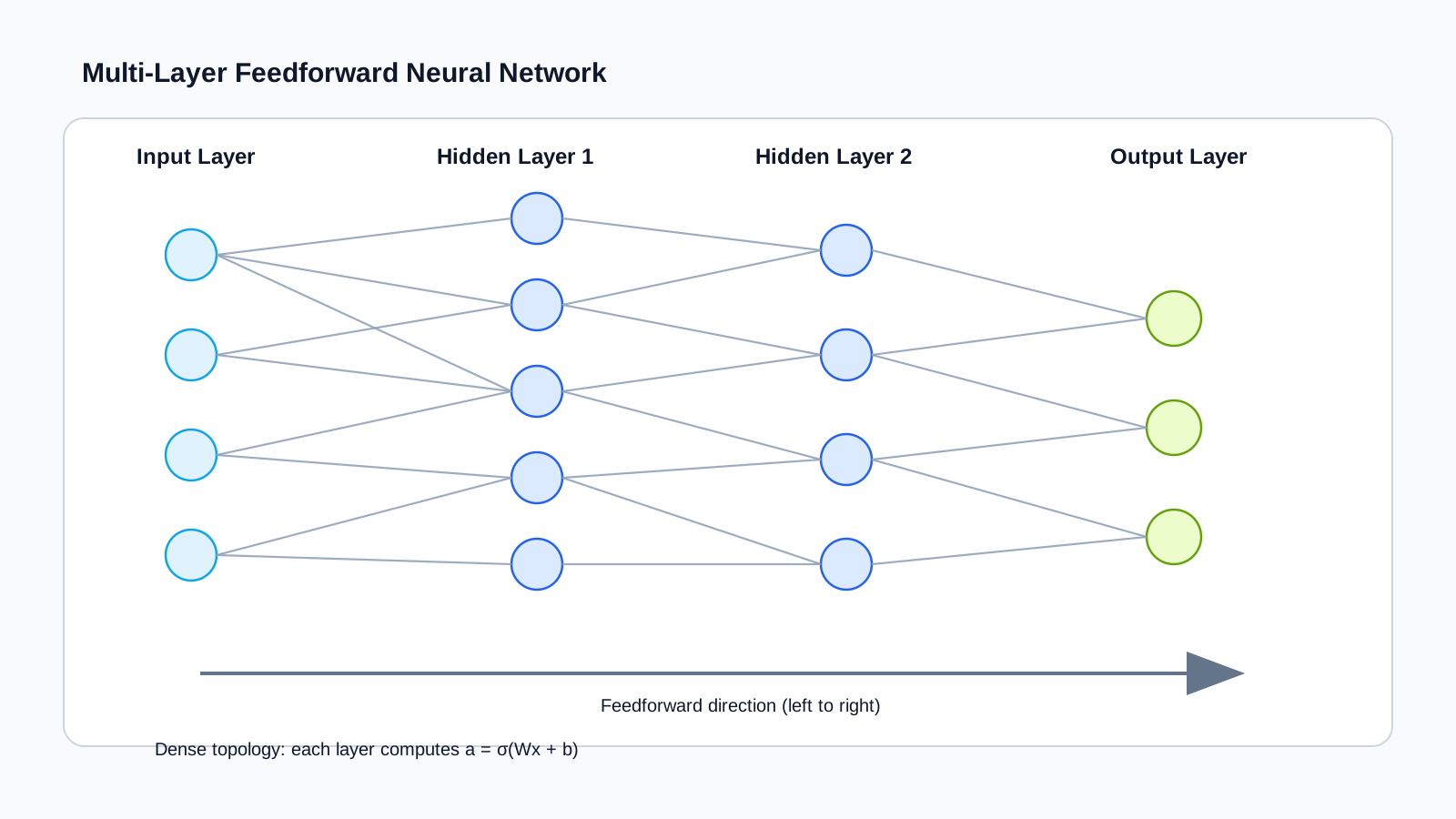
Input layer
The input layer receives feature vectors. It does not learn transformations itself; it defines dimensionality and data interface.
Hidden layers
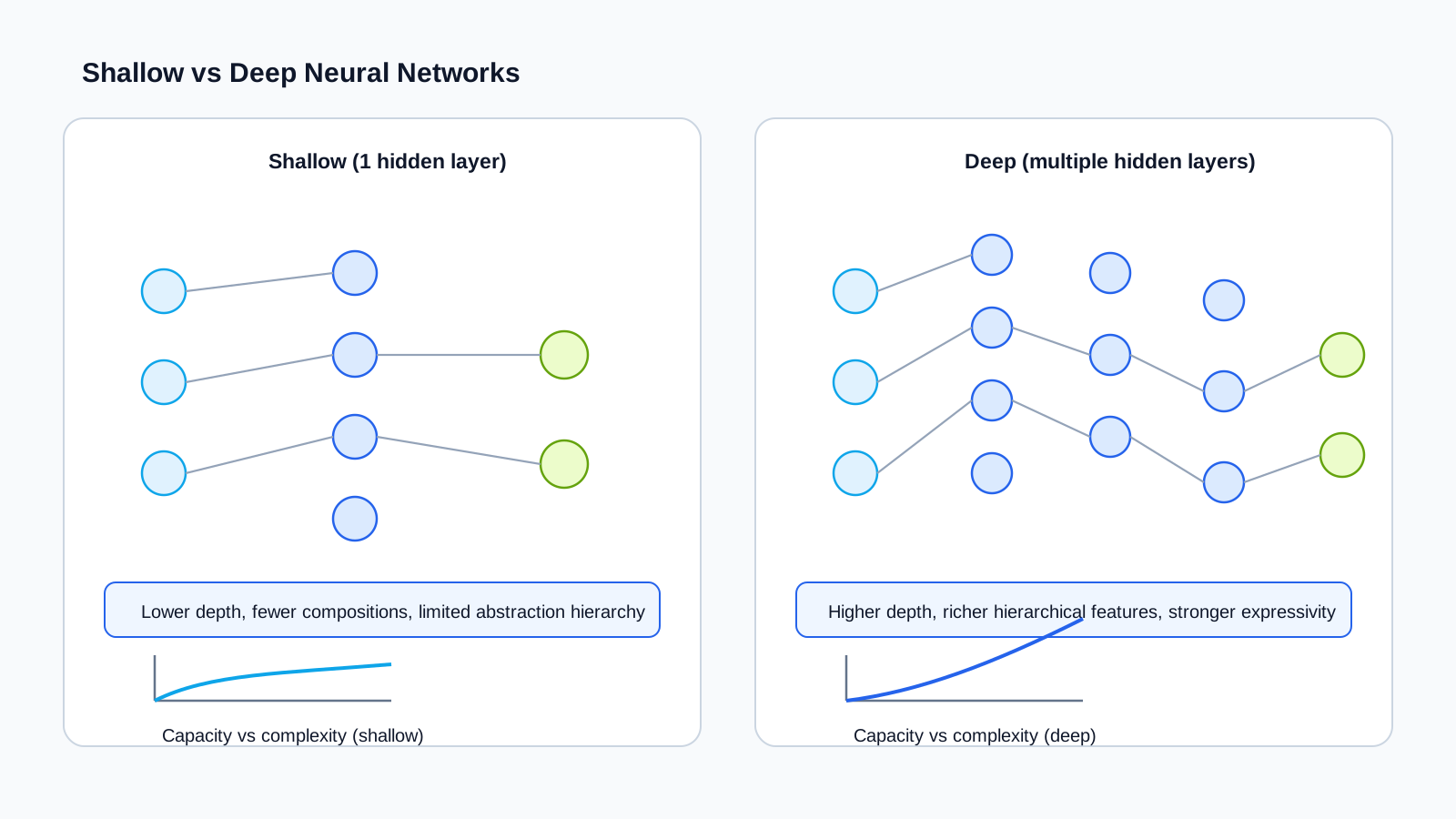
Hidden layers learn intermediate representations. Lower layers often capture local or simple patterns, while deeper layers capture increasingly abstract features.
Output layer
The output layer maps internal representation to task-specific outputs:
- Linear output for regression.
- Sigmoid for binary classification.
- Softmax for multi-class classification.
Feedforward process
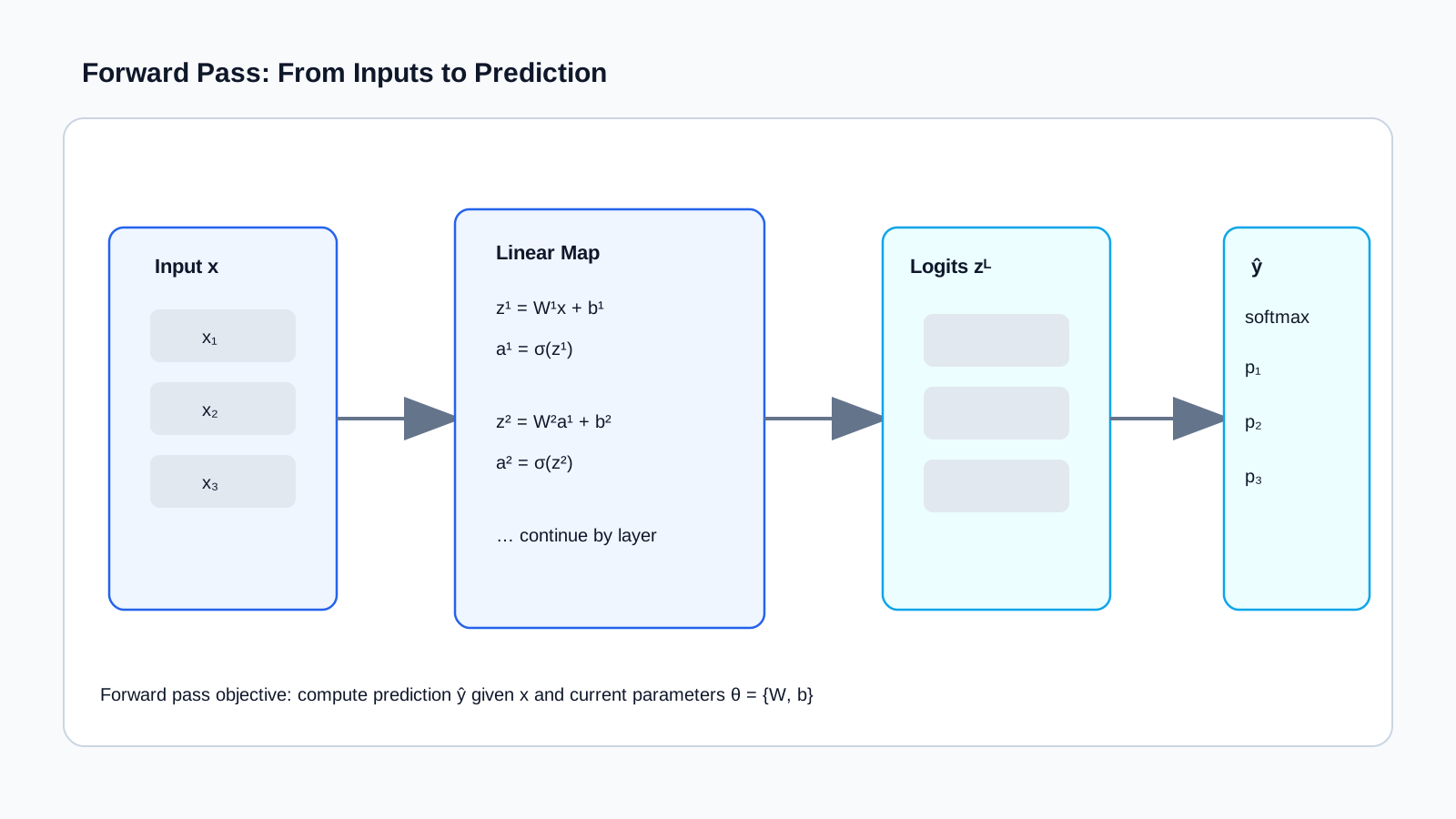
In feedforward computation, information moves from input to output through deterministic layer operations.
Backpropagation explained step by step
Error computation
- Run a forward pass to compute
y_hat. - Compute loss
L(y, y_hat).
Gradient calculation
- Differentiate loss with respect to output-layer parameters.
- Propagate gradients backward through each layer using the chain rule.
- Accumulate
dL/dW_landdL/db_lfor all layersl.
Weight updates
- Update parameters with an optimizer (SGD, Adam, etc.).
- Repeat over mini-batches until convergence criteria are met.
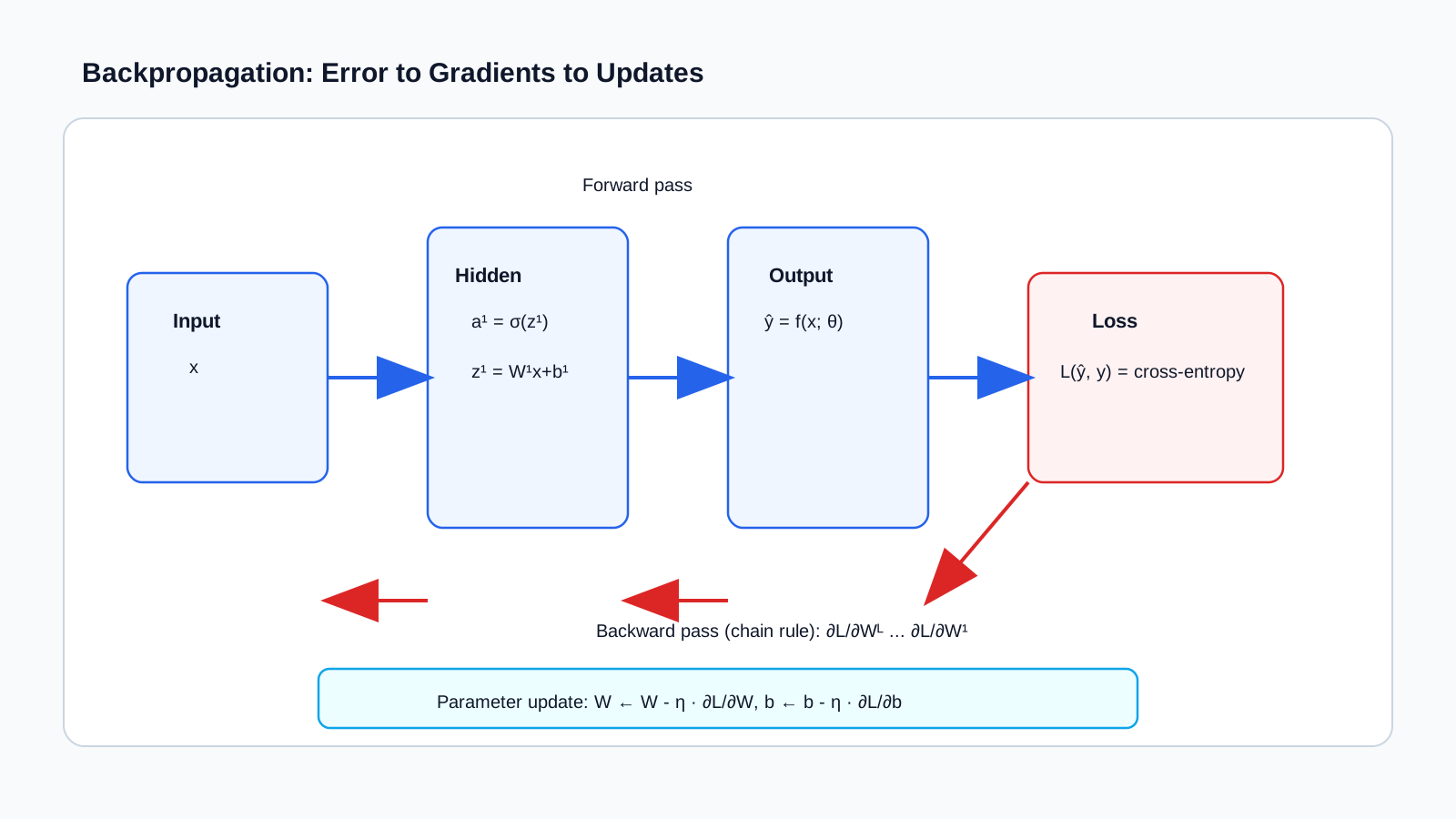
This is the operational meaning of backpropagation explained: efficient gradient transport through compositional functions.
Types of neural networks
MLP
A Multi-Layer Perceptron uses dense fully connected layers and is suitable for tabular data and baseline classification/regression tasks.
CNN
Convolutional Neural Networks use local kernels and weight sharing, making them highly effective for image and spatially structured inputs.
RNN
Recurrent Neural Networks process sequences by carrying hidden state through time. LSTM and GRU variants address some stability issues in long dependencies.
Transformers
Transformers rely on self-attention to model token interactions in parallel. They are now dominant in NLP and increasingly used in vision and multimodal systems.
Practical example
Simple pseudo-code
# Initialize model parameters theta
for epoch in 1..E:
  for (x_batch, y_batch) in data_loader:
    y_hat = model.forward(x_batch)
    loss = criterion(y_hat, y_batch)

    optimizer.zero_grad()
    loss.backward()      # computes gradients via backpropagation
    optimizer.step()     # updates weights and biases
Conceptual training pipeline
- Collect and clean data.
- Split into train/validation/test sets.
- Normalize or standardize features.
- Define architecture and loss.
- Train with mini-batches and monitor validation metrics.
- Tune hyperparameters (learning rate, depth, regularization).
- Evaluate on held-out test data.
- Deploy with monitoring for drift and performance decay.
Limitations and challenges
Overfitting
When model capacity is high relative to effective data diversity, training error can decrease while generalization worsens. Mitigation includes regularization, dropout, data augmentation, early stopping, and cross-validation.
Vanishing gradients
In deep or recurrent settings, repeated multiplication by small derivatives can shrink gradients, slowing or blocking learning in early layers. Residual connections, normalized activations, and careful initialization help.
Data requirements
High-performing neural systems often require large, representative, and clean datasets. Bias, label noise, and distribution shift can cause severe downstream failures.
Conclusion
Key takeaways
- Artificial neural networks are optimization-driven function approximators built from affine transforms and nonlinear activations.
- Training relies on loss minimization with gradient-based updates.
- Backpropagation is the computational mechanism that makes deep models trainable.
- Architecture choice (MLP, CNN, RNN, Transformer) should match data structure and task constraints.
- Reliability depends as much on data quality and evaluation protocol as on architecture depth.
Future directions
Current directions include more efficient architectures, better interpretability, robust training under distribution shift, and tighter integration between foundation models and domain-specific adapters. For practitioners, the durable skill is not memorizing one architecture, but understanding the principles that govern how neural networks work across model families.